I
The Lead Box
Nothing went from one surface to another in the reading room of the Marchmont Archive Trust without a line on the custody sheet. Each line took a signature and a time. Above the lines the sheet had three fields, accession, provenance and condition, and on Thursday 12 November 2026 all three were full. The reading from the logger on the wall was entered beneath them, 18.1 °C and 47 per cent RH at 09:40.
The accession field read MAT 2026/41. The provenance field gave a box of lead, sealed, found during the contractor’s groundworks on 3 November in the 1894 footings of the former Marchmont Hospital, 2.3 m below the slab. It was sent to the trust on the 4th under the planning condition, 262 by 214 by 63 mm and 7.0 kg as received.
The first line below the fields was the handover, signed by the contractor’s site manager on the front step at 11:20 on the 4th. The trust rented the ground floor of a converted house near the site, and the step counted as a surface.
The second line was the cut. M. Holt, conservator, had cut the seam on 5 November at 14:10 before C. Vance and a witness from the contractor. All three had signed. A photograph reference stood against every stage, P1 to P13. The last showed the volume lying in its oilcloth. Clara read the whole sheet through, as the trust had her do each time she added a line.
The condition survey and its prints lay in the folder under her left hand. She had gloves on for the prints. Box and lid came to 5.6 kg empty, which left 1.4 kg for the oilcloth and what it held. For the survey the front board of the volume had been raised once, for one exposure, and let down again.
No leaf had been turned. None would be until it had a folio number and an open sheet, and the trust read in folio order, whoever was reading.
The inside front board was not a leaf. Holt’s entry for it gave an ownership inscription, upper third of the board, 31 mm below the head, brown ink, not sampled, photograph reference P22. It gave the wording as the print showed it, “Clara Vance, her chronicle”. Below that the notes field held one line in Clara’s writing, dated 5 November. It recorded that the name as inscribed was also the cataloguer’s.
Holt had made the exposure a week ago, at the camera stand on the far side of the room, with her back to Clara. “Lead, oilcloth and a label. It’s come to the right desk.”
The third line was the cataloguer’s. Under the trust’s rule a single volume from a contractor’s find went to the assistant next on the rota. The rota had come round to Clara. Holt had assigned her the bench when the cut showed one volume in the oilcloth. The line read C. Vance, placement student, in Clara’s writing, and beneath it Holt had countersigned as supervisor.
She drew the print out and squared it to the edge of the folder, and she took off her left glove. No step on the sheet asked for that. She laid the glove on the table and the bare hand beside it, clear of the print.
The fourth line took the box, its lid and the volume into the cold store at 16:52 on the 5th. The fifth brought them out to the bench at 09:15 on the 12th. The sixth was for the witness and was still blank.
The trust’s letter of engagement was clipped to the sheet, dated 4 November. It gave its reason in one sentence. A sealed box beneath a hospital for nervous diseases might hold patient records, and a medical witness should attend the opening of whatever it held. Dr P. Raman, consultant neurologist, had given the 12th as her first free morning, so the volume had waited a week.
Raman came in at 09:55 with her coat over her arm and her reading glasses in her hand. Clara turned the sheet round on the table with her right hand and moved the folder and the print across after it. Raman put the glasses on and read standing, from the accession down, then the survey entry, then the print. She read the print twice.
She took the glasses off and looked at the glove on the table, and then at the third line of the sheet. “Which line does the witness sign?”
“The sixth,” Clara said. She laid the pen across the witness line. “Sign there, please.”
Raman printed her name and signed with the sheet’s pen, the one ink allowed in that room. Clara wrote 09:58 beside the signature and signed the line as cataloguer. She took off the right glove and dropped the pair in the bin. She drew a fresh pair from the carton by the door and lifted the folder.
On the conservation bench lay the box, its lid, the cut edge of the lead turned from the lamp, the oilcloth unfolded to its creases with the volume on it, the cradle, the snake weight, a soft pencil and a stack of blank catalogue sheets. The cut had been bright on the 5th and had gone dull in the week. The blind was down. Holt kept the lux hours on a card clipped to the lamp.
Holt read the light at the cradle, 50 lux, before anything moved. She stood at the near end by the camera stand, in her apron, with her gloves on. Raman hung her coat on the door and took the stool at the far end. She put the glasses on and folded her hands away from the work.
Holt photographed the volume on the oilcloth. At 10:14 she lifted it on both hands and laid it on the cradle, then photographed the oilcloth empty. Its creases had kept the outline of the boards. Clara wrote the transfer on the custody sheet with both references. She took the top catalogue sheet, which was for the volume as a whole.
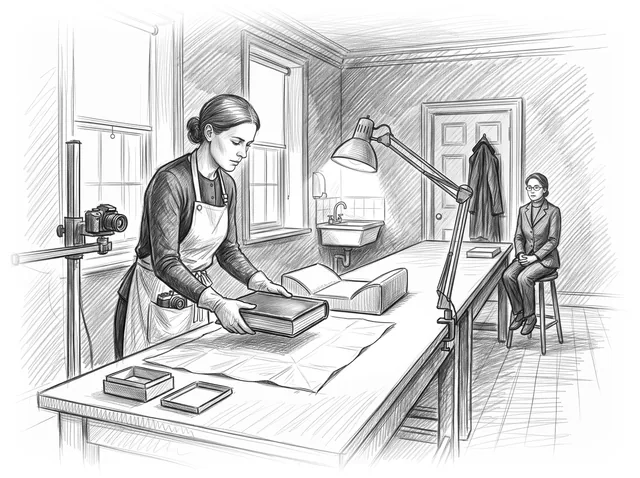
The binding was leather, dressed at some time, and the dressing had dried dull and took a mark from anything. Holt had laid out nitrile for it, not cotton. The wear was at the head and tail of the spine and at the two lower corners. Clara laid the rule along the board and then across it, and wrote 228 by 184 mm.
Holt raised the front board over to the wing of the cradle, and the spine made no sound. She laid a sheet of blotting paper across the first leaf while the board was still coming down. It covered the writing and left the outer margin bare. The inscription lay where the survey put it. Clara checked the 31 mm with the rule and ticked it.
Wove paper, no watermark at this angle, foxing at the outer margin. The ends of the lines showed along the blotter’s edge. The ink had gone brown. She entered the colour.
Holt counted from the fore-edge with the block shut, lifting the corners on a spatula and letting each one fall. She counted fifty and laid the rule to them, then to the whole block. “Five millimetres to the fifty. Thirty in the block.”
Clara entered the extent as about 300 leaves, estimated. As Holt settled the block it gave near its middle and fell open a few degrees before her palm came down. At that opening the text ran into the gutter on both sides. Clara entered it under physical description. Holt closed the block and laid the snake weight along the blotter.
“No hospital stamp and no casebook ruling,” Raman said from the end of the bench. Her hands had not moved. Clara wrote it in the notes field, with the name and the time against it.
The next line on the custody sheet gave the witness’s part in full, volume to cradle, front board raised, no leaf read. Clara carried the sheet and its pen to the far end of the bench, away from the cradle. Raman read the line and signed it at 10:41. She took off the glasses and lifted her coat from the door. The street door closed behind her. Holt drew off the blotter.
Holt moved the stool back to the wall and took up the soft pencil. She wrote 1 in the upper outer corner of the first recto. Clara tucked her lanyard inside her lab coat and opened a sheet for the leaf, nine fields and a line at the foot for who had examined it and when. She filled in the reference, the physical description and the condition before she read a line. Supplied titles went in square brackets, and she supplied none.
With the sheet open, Holt swung the camera over the cradle and took the recto. Clara read with a slip of card held under the line, to keep the line below it covered. Each side was ruled across for thirty-one lines. The ink ran dark and pale by turns, every seven or eight words, where a pen had been dipped.
At the foot of the recto Holt turned the leaf on the spatula, laid the blotter on the facing recto and took the verso. Clara read the verso the same way. The sheet had one line for the hand, and she wrote “upright, small” in it.
She signed and timed the foot of the sheet at 11:24 and turned it face down on her left. Holt pencilled 2. The sheet for f. 1 had taken thirty-nine minutes. Between exposures Holt had bagged the oilcloth and labelled the bag.
A leaf took as long as its sheet took. At f. 2 Holt pointed with the tip of the spatula. “Closed tear, lower corner.” Clara put the rule to it, 14 mm. An old fold crossed the lower third of f. 3. The head of f. 4 had cockled. Holt set a second weight along it.
From 13:05 to 13:30 the volume lay under tissue behind a locked door. Rain came on while f. 5 was open. Its sheet was signed at 14:21 with tyres going by outside. The foxing at the outer margin thickened through that leaf and thinned again by the next. The sheet for f. 6 was signed at 14:58. The sheets for f. 1 to f. 6 all said the same in the line for the hand.
Holt pencilled 7 at 15:02. When Clara had its sheet open, Holt took the recto. At 15:24 she turned the leaf, took the verso and checked it on the camera’s screen as she had checked the others. Then she took the day’s spatulas and brushes to the sink and washed them one at a time, laying each on a cloth to dry.
Clara brought the slip down the verso a line at a time. The first hand went on through eighteen lines. In line 19 it reached the middle of the line and stopped at the end of a word. A second hand went on with the next.
The gap between the two words was no wider than the gaps in the line above. The last word of the first hand was pale and the first word of the second was dark, where a pen had been dipped.
The first hand had been upright and small and had kept to the ruled line. The second was larger and leaned. She laid the rule beside it. A small letter stood 3 mm where the first hand’s had stood 2 mm. She brought the slip on down. From line 20 the lines ran past the ruling into the margin. At the foot of the leaf she took the slip away.
At the sink Holt laid the last brush on the cloth. “Two hands. Or one hand on a bad day.”
Clara did not answer. She bracketed the change on the sheet against the line number. Then she went back to the top of the leaf and counted the lines. There were thirty-one, as on every side before it, and she entered the count. Outside, a bus went by on the wet road. The sheet had one line for the hand, and she wrote A and B in it, and after them 19, where B began.
She signed and timed the foot of the sheet at 15:44 and turned it face down on her left. Holt dried her hands and pulled on a fresh pair of gloves.
The print of the inside front board was in the folder. Clara laid it on the bench beside the cradle, level with the leaf, and brought the lamp across until it lit both. The inscription leaned as the second hand leaned and was of its size. Each h in it had the same open loop as each h after the change. She went through them one at a time as far as line 31.
Holt came over and took one exposure of the print beside the leaf. She gave Clara the reference, P47. Clara opened a sheet for the board. In the line for the hand she entered Hand B, with P22, P47 and the lines compared, f. 7v, lines 19 to 31. Under physical description she wrote that it was an inscription, a feature of the object. She left the notes field empty and signed and timed the sheet at 15:52.
A sheet took the better part of forty minutes. The bench closed at 16:15, and no leaf stayed open overnight. Holt put the pencil down beside the blank sheets. The next leaf lay under the blotter with no number on it, so it was not a leaf Clara could read. She laid the snake weight along its fore-edge.
The box and its lid went to the cold store first, bagged, on the trolley. The volume followed at 16:18 on a padded board, with Holt carrying it and the light going in the passage window. In the store the air handling ran and the logger read 13.2 °C and 39 per cent RH. Clara stopped in the door with the volume’s sheet and the custody sheet on one clipboard. She wrote the reading in and left the time of the transfer blank.
Nothing that had been on the cradle went back on a shelf until Holt had checked the sewing. She set the board on the steel table inside the door. She slid a spatula under the back board of the volume and raised it by the width of two fingers, then bent and looked along the head of the block at the folds.
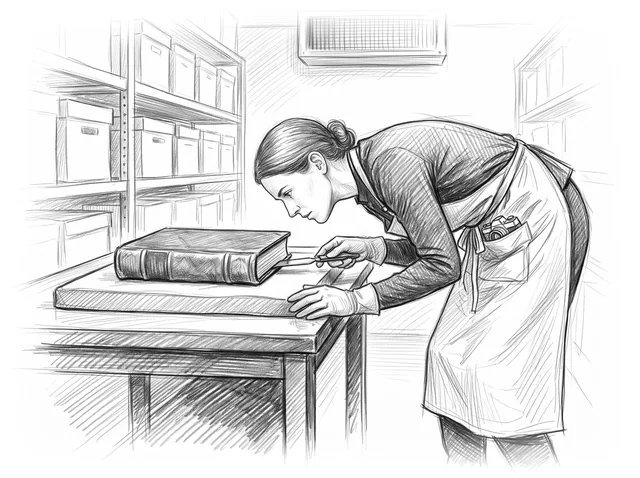
Her thumb went along the fore-edge at the back of the block, stopped, and went along it again. She took the small camera from her apron and made one exposure of the head before she spoke. “Sewing’s sound. This one isn’t sewn. Singleton, tipped to the last gathering. Heavier stock, by the edge.”
It had no number. The pencil was on the bench in the other room, where it had stopped at f. 7. The table was two steps from the door, and the gap under the back board faced that way.
“How much heavier?” Clara said.
“Nobody reads it till it has a number,” Holt said, without looking up. “That includes you and it includes me.”
Clara did not look. She entered the singleton on the volume’s sheet, then wrote 16:27 on the custody sheet in the space she had left and signed against it. Holt drew out the spatula and let the board down on the leaf. She carried the volume to the second shelf of the second bay. At the door she signed under Clara’s name. She locked the store and put the key on her lanyard.
MAT 2026/41 stood foliated to f. 7. Its extent was entered as about 300 leaves, estimated. The last leaf was not foliated and not read. The line for the day was signed by both and timed at 16:29.